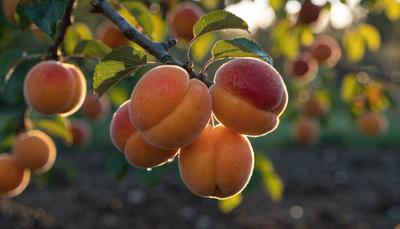
A ripe nectarine off your own tree — skin so smooth it shines, flesh so juicy you eat it over the sink — is one of the great rewards of the home orchard. Nectarines are genetically almost identical to peaches (a single recessive gene gives them their fuzz-free skin), so if you can grow a peach, you can grow a nectarine. The catch is that same smooth skin makes them a little more vulnerable to brown rot and thrips, which is exactly where an organic, soil-first approach earns its keep: a tree grown in biologically alive soil is a tree that defends itself. This guide walks you from cultivar selection through the last sun-warm fruit of the season.
Skip to the feeding schedule →
Choosing the Right Nectarine Variety
Nectarines are perennial stone fruit, hardy roughly across USDA zones 5–9 (a few tough cultivars stretch to zone 4, and low-chill types reach into zone 10). The single most important number when choosing a tree isn't the flavor — it's chill hours: the cumulative hours between about 32°F and 45°F a tree needs each winter to break dormancy and set fruit properly. Match this to your climate first, then worry about taste.
Match Chill Hours to Your Climate
If you live where winters are cold (zones 5–7), you want a high-chill cultivar (700–900+ hours). If you're in a mild-winter region (zones 8–10, the Southeast, coastal California, the low desert), a high-chill tree will leaf out erratically and drop its blossoms — you need a low-chill variety instead.
- Low-chill (250–550 hours): 'Panamint', 'Desert Delight', 'Arctic Star' (a superb white), 'Sunraycer', and the genetic-dwarf 'Nectar Babe' and 'Necta Zee'.
- Mid to high-chill (500–900 hours): 'Fantasia' (a reliable, moderate-chill yellow freestone and one of the best all-around home varieties), 'Redgold', 'Flavortop', 'Independence', and 'Sunglo'.
- Cold-hardy (for zones 4–6): 'Hardired' and 'Mericrest' — both bred for disease tolerance and late bloom that dodges spring frost.
Freestone vs. Clingstone, Yellow vs. White
A freestone nectarine's flesh pulls cleanly off the pit — ideal for slicing and eating fresh. A clingstone holds tight to the pit; these are often the earliest, sweetest, and best for preserves. Yellow-fleshed nectarines ('Fantasia', 'Redgold') have that classic tangy-sweet balance; white-fleshed ones ('Arctic Star', 'Snow Queen') are lower in acid and honey-sweet, a favorite of anyone who finds peaches too sharp.
Size and Pollination
On vigorous, full-size rootstock like 'Lovell' or 'Nemaguard', standard trees reach 12–15 feet; look for cultivars grafted onto a semi-dwarfing 'Citation' rootstock for an 8–12 foot tree that's far easier to spray, thin, and harvest. Genetic dwarfs like 'Nectar Babe' top out around 5–6 feet and thrive in a half-barrel on a patio. The good news for small gardens: nearly all nectarines are self-fruitful, so a single tree will set a full crop with no pollinizer partner needed.
Soil Preparation
The Ideal Soil
Nectarines demand one thing above all: drainage. Their roots will not tolerate "wet feet," and soggy soil is the fast lane to root rot and short-lived trees. Aim for a loose, well-draining loam with a slightly acidic to neutral pH of 6.0 to 7.0. If you have heavy clay, plant on a raised mound 12–18 inches high and 3–4 feet wide rather than digging a hole that becomes a bathtub. A simple percolation test tells you what you're working with: dig a 12-inch hole, fill it with water, and if it hasn't drained within a few hours, you need to mound.
Building Living Soil
Here's the organic difference. Conventional growing feeds the plant; organic growing feeds the soil, and the soil feeds the plant. A nectarine tree lives in the same spot for 15–20 years, so you're not fertilizing a season — you're cultivating a living ecosystem of bacteria, fungi, and earthworms that slowly release nutrients and build the mycorrhizal partnerships that make a tree drought-resilient and disease-tough.
Start with generous composting worked into the top 12 inches of your planting area — 2–3 inches of finished compost is a strong foundation. In the years before you plant (or in the open ground of a young orchard), sow a cover crop like crimson clover or vetch; these legumes fix nitrogen, and when you chop and drop them, they feed the soil food web for free. Top everything with 3–4 inches of wood-chip or straw mulch, kept a few inches back from the trunk, to hold moisture, suppress weeds, and feed the fungal life that fruit trees especially love.
Planting: Timing & Technique
Plant bare-root nectarines in late winter to early spring, while the tree is still dormant and the soil is workable — this gives roots weeks to establish before the canopy makes demands. Container-grown trees can go in through spring and into early fall in mild climates, as long as you avoid the peak heat of midsummer.
A note on seeds: you can sprout a pit, and it's a fun experiment, but nectarines don't come true from seed — the fruit won't match the parent, and you'll wait 3–5 years to find out. It's the same lesson gardeners learn starting seeds indoors for many fruits: for a predictable, named cultivar on quality rootstock, buy a grafted tree. Save seed-starting for your annuals.
Technique: Dig a hole twice as wide as the root ball but no deeper than the roots themselves — you want the graft union (the swollen knuckle low on the trunk) sitting 2–3 inches above the soil line. Spread bare roots over a small cone of native soil, backfill with the same native soil (don't over-amend the hole, or roots circle instead of venturing out), water in deeply to settle air pockets, and mulch. Space standard trees 15–18 feet apart, semi-dwarfs 12–15 feet, and dwarfs 6–8 feet. Finish by cutting a new whip back to about 30 inches to force low scaffold branches — the foundation of an open-center tree.
Companion Planting
An organic orchard is a polyculture, not a monoculture. The right neighbors pull in pollinators and predatory insects, confuse pests, and build the soil under your tree. Nectarines respond especially well to a living guild beneath the canopy — see the full companion planting guide for the broader logic.
- Alliums (garlic, chives) ringing the trunk: their onion scent deters aphids and confuses pests hunting by smell.
- Daffodils (Narcissus) around the base: their toxic bulbs help discourage burrowing rodents like voles from gnawing bark and roots.
- Comfrey: the orchard workhorse. Its deep taproot mines minerals from the subsoil; chop the leaves 2–3 times a season and drop them as a potassium-rich mulch right where fruiting trees want it.
- Nasturtium and yarrow: nasturtium acts as an aphid trap crop; yarrow and dill draw in the ladybugs, lacewings, and parasitic wasps that clean up pests for you.
- Clover or a low legume living mulch: fixes nitrogen underfoot and keeps the soil covered and cool.
One thing to avoid: don't plant a nectarine within about 50 feet of a black walnut, whose roots release juglone, a compound toxic to stone fruit.
Watering Nectarines Organically
Nectarines want deep, infrequent watering rather than frequent sips — roughly 1–2 inches per week, delivered so it soaks the full root zone and then dries slightly before the next round. Deep watering trains roots downward, where they're insulated from heat and drought; shallow daily watering builds a lazy, surface-bound root system.
The critical window is fruit sizing, from pit-hardening through the final swell before harvest — water stress here means small, mealy fruit. But ease off slightly in the last week or two before picking: a touch less water concentrates the sugars and intensifies flavor. The organic mandate: water the ground, not the tree. A drip line or soaker hose that keeps foliage and fruit dry does more to prevent brown rot and leaf curl than any spray. Wet leaves overnight are an open invitation to fungus. A thick mulch layer buffers the whole system, holding moisture through dry spells and evening out the wet-dry swings that stress the tree.
Organic Fertilizing Schedule for Nectarines
Fruit trees are heavy feeders, but the goal isn't to blast them with nitrogen — it's to keep the soil biology fed so nutrients release in step with the tree's needs across the season. Too much nitrogen late in the year gives you lush leaves, soft growth that invites disease, and fewer flower buds. Feed with the stages, not against them.
You don't need all of these — Microbes, Veg, and Bloom are the core; the rest are optional boosters.
At Planting & Establishment
Start life in the root zone. Drench new and dormant-breaking trees with Microbes to inoculate the soil with the bacteria and fungi that build the mycorrhizal network a long-lived tree depends on. Pair it with Kelp It Real for root growth and transplant-stress resilience — seaweed's natural hormones help a young tree push roots and shrug off the shock of a new home.
Spring Leaf-Out (Vegetative)
As buds swell and the canopy flushes, the tree wants nitrogen to build leaves and new wood. Feed Veg to drive strong, healthy foliage — the solar panels that will ripen your crop — and keep Microbes in rotation so the biology stays active and keeps converting your compost and mulch into plant-available food.
Bloom & Fruit Set
When blossoms open and set into tiny fruit, shift the balance toward phosphorus and potassium with Bloom to support flowering and a strong fruit set. A dose of Kelp It Real here helps the tree hold its set through the temperature swings of spring. This is also the moment to thin your fruit — brutal as it feels, remove fruitlets to about one every 6 inches. A tree left to carry everything gives you a hundred marbles instead of thirty jewels.
Fruit Sizing (The Swell)
Now the fruit bulks up, and this is where a power-up pays off. Incredible Bulk is built for exactly this stage — bigger, denser harvests — feeding the fruit as it moves from pit-hardening into its final swell. Keep Bloom going alongside it to carry the tree through to ripeness.
Harvest & Post-Harvest
Ease off. As fruit colors up and you begin picking, back down on feeding — heavy nitrogen now delays ripening and softens the tree for winter. Keep only Microbes ticking over to keep the soil alive through the tail of the season. There's no "flush" in organic growing; you're simply letting the tree wind down naturally into dormancy, its energy shifting to root reserves for next year's crop.
Organic Pest Control
The nectarine's smooth skin is a magnet for a handful of stone-fruit pests. The organic playbook is prevention and timing — a healthy tree, good sanitation, and well-timed treatments — not spraying on a calendar out of fear. For the full toolkit, see the organic pest control guide.
- Oriental fruit moth & peach twig borer: the classic "worm in the fruit." Hang pheromone traps to time your response, spray Bacillus thuringiensis (Bt) or spinosad against young larvae, and use mating-disruption dispensers in larger plantings.
- Plum curculio & stink bugs: these scar and dimple the fruit. A coating of kaolin clay (Surround) dusts the tree white and makes it an unappealing landing pad; spread a sheet and jar the branches early morning to knock curculio down.
- Aphids (green peach aphid): curl new leaves in spring. A strong jet of water, insecticidal soap, or simply the ladybugs your yarrow and dill attract will handle a normal population.
- San Jose scale & spider mites: knock down overwintering eggs and scale with a dormant horticultural oil spray in late winter — one of the highest-value sprays in the whole calendar.
- Peachtree borer: watch the lower trunk for gummy, sawdust-flecked ooze near the soil line; keep the trunk base clear of mulch and injury, and the tree can usually wall off the damage itself.
Common Diseases & Organic Solutions
Because their skin lacks the protective fuzz of a peach, nectarines are the more disease-prone of the two — which makes the dry-foliage watering and good airflow above worth double the effort.
- Brown rot (Monilinia fructicola): the number-one nectarine disease — blossoms wilt, and fruit rots into fuzzy tan mummies, often overnight near harvest. Control it with ruthless sanitation: remove and destroy every mummified fruit and cankered twig, prune for open airflow, and apply organically approved sulfur at bloom and again as fruit ripens in humid seasons.
- Peach leaf curl (Taphrina deformans): puckered, red, blistered spring leaves. The only effective timing is dormant — one spray of copper or lime-sulfur after leaf-drop in fall and/or just before bud-swell in late winter. Once you see curled leaves, it's too late for the season.
- Bacterial spot (Xanthomonas arboricola pv. pruni): dark, angular flecks on leaves and cracked, pitted fruit. There's no cure mid-season, so this is won at the nursery — plant resistant cultivars like 'Hardired' and 'Mericrest' — supported by dormant copper.
- Shot hole & powdery mildew: shot hole leaves tan spots that drop out like BB holes; powdery mildew coats new growth in white felt. Both respond to the same dormant copper and growing-season sulfur, plus pruning for airflow.
Harvesting Nectarines
The hardest lesson in stone fruit: a nectarine will soften after picking, but it will not get sweeter. All the sugar it will ever have is set on the tree, so patience here is everything. Judge ripeness by three signs working together:
- Ground color: the background skin (not the red blush) shifts from green to a warm yellow, cream, or gold. The blush tells you the cultivar; the ground color tells you the ripeness.
- Give: the fruit yields to gentle pressure along the shoulders near the stem, not just at the tip.
- Aroma and release: a ripe nectarine smells sweet and floral, and lifts off the branch with a slight twist rather than a hard pull.
A tree ripens over 1–2 weeks, so plan on several pickings, taking only the ready fruit each pass. Handle them like eggs — bruises turn to rot fast. Eat tree-ripe fruit within a few days, or refrigerate to slow it down; let refrigerated fruit come back to room temperature before eating to wake up the aroma.
Common Problems & Troubleshooting
Why is my nectarine tree flowering but not setting fruit?
Usually a chill-hours mismatch or a spring frost. A high-chill tree in a mild climate blooms erratically and drops blossoms; a late frost can kill open flowers outright. Confirm your cultivar suits your zone, and protect early bloomers on frost nights with a cover. Rarely, a total lack of pollinators in a cold, wet spring is the culprit — hand-pollinating with a soft brush can help.
Why is my fruit small, dry, or mealy?
Three common causes: overloading (a tree carrying too much fruit rations it thin — thin harder next year), water stress during the sizing window, or picking too early, before sugars developed. Address the first two with disciplined thinning and steady deep watering, and let the fruit hit full ground color before you pick.
Why are my leaves curled, red, and blistered in spring?
That's textbook peach leaf curl. The frustrating truth is you can't fix it once you see it — the infection happened weeks earlier at bud-swell. Rake and destroy fallen infected leaves, keep the tree well fed and watered so it can push a healthy second flush, and mark your calendar for a dormant copper or lime-sulfur spray this fall and late winter. That single dormant spray is the whole cure.
Frequently Asked Questions
How long until a nectarine tree bears fruit?
A grafted nursery tree typically gives you a first light crop in 2–3 years and hits full production by year 4–5. Genetic dwarfs often fruit a bit sooner. Trees grown from a pit take far longer and won't match the parent fruit.
Do I need two nectarine trees to get fruit?
No. Almost all nectarine cultivars are self-fruitful, so a single tree will produce a full crop on its own. A second tree or nearby peach can modestly boost set, but it's never required.
Can I grow a nectarine in a container?
Yes — choose a genetic dwarf like 'Nectar Babe' or 'Necta Zee' in a half-barrel or 15–20 gallon pot with excellent drainage. Container trees dry out faster, so watch watering closely, and feed a bit more often since nutrients flush out with each watering.
Why does my nectarine drop small fruit in early summer?
Some drop is completely normal — it's called June drop, the tree self-thinning fruit it can't support. Only worry if drop is heavy and paired with pest damage or drought stress. In most cases it's the tree doing your thinning for you.
How do I prune a nectarine tree?
Prune in late winter to an open-center (vase) shape — 3–5 main scaffold limbs and an open middle that lets sun and air reach every fruit. Nectarines fruit on one-year-old wood, so each year you're removing old, spent wood to encourage the fresh growth that will carry next season's crop. Don't be timid; these trees respond to a firm annual cut.